Capabilities and compatibility
LYRouter serves three chat endpoints, Chat Completions, Anthropic Messages and Responses, plus image, video, audio and other endpoints, from a single address. Whether a call succeeds and whether its params take effect depend on the chosen model and the channel that actually serves it. The gateway converts automatically between Chat Completions and Anthropic Messages, while Responses requests are forwarded unchanged to the channel's Responses endpoint. When the model does not support the requested endpoint or input, the gateway returns 400 directly; image and video endpoints drop some params the model does not support and list them in a response header.
Endpoints and channel protocols
Each channel uses one upstream protocol: OpenAI-compatible or Anthropic. The gateway decides whether to convert a request based on the channel protocol:
| Endpoint the client calls | What the gateway does | When choosing a model |
|---|---|---|
Chat Completions (/v1/chat/completions) |
OpenAI-compatible channels receive it as-is; for Anthropic-protocol channels it is first converted into a Messages request, and the response is converted back | Any chat model works |
Anthropic Messages (/v1/messages) |
First converted into the internal Chat Completions structure, then sent according to the channel protocol | Any chat model works; the model does not have to come from Anthropic |
Responses (/v1/responses) |
No protocol conversion; forwarded unchanged to the channel's Responses endpoint | The channel must provide a Responses endpoint; Anthropic-protocol channels do not have one |
When calling through /v1/messages, error responses are converted to the Anthropic format as well, with only error.type and error.message and no error.code.
How params are handled during conversion
Cross-protocol conversion keeps only fields that have a matching meaning on both sides and removes the rest; these removals are not reported in response headers. If your application relies on the params below, confirm the protocol of the channel that actually serves it:
| Direction | Handling |
|---|---|
| Chat Completions → Anthropic-protocol channel | Removes fields such as n, logprobs, top_logprobs, response_format, frequency_penalty, presence_penalty, seed, parallel_tool_calls, logit_bias and reasoning_effort; converts stop to stop_sequences; adds 4096 when there is no max_tokens; converts enable_thinking and thinking_budget to Anthropic's thinking setting |
| Anthropic Messages → OpenAI-compatible channel | Converts model, messages, system, max_tokens, stop_sequences, tools, tool_choice and thinking by meaning; keeps stream, temperature, top_p, top_k and service_tier as-is; removes other fields, including the cache_control markers on messages and tools |
The three reasoning params reasoning_effort, enable_thinking and thinking_budget belong to different providers, and the gateway does not convert between them; for providers it has adapted, it removes the ones that provider does not recognize. When a model is served by several channels, verify JSON output, reasoning and caching behavior on each channel; see Connecting multiple providers.
Requests the gateway rejects
Before sending a request, the gateway checks the endpoint and input against the capabilities declared in the model catalog. When they do not match, it returns 400 directly, without calling the upstream or moving to a fallback model:
Error message (error.message) |
error.code |
Cause and fix |
|---|---|---|
This model does not support the <api_type> API |
unsupported_model_api |
The endpoints the model declares do not include the current one, for example a chat model calling /v1/images/generations, or a model that declares only Chat Completions calling /v1/responses. <api_type> is one of chat_completions, responses, embeddings, rerank, images, videos and audio. Switch to a model that supports the endpoint |
This model does not support the <operation> operation |
unsupported_model_operation |
The endpoint family is supported, but the specific operation is not, for example a text-to-image-only model calling /v1/images/edits |
This model accepts text input only |
unsupported_model_input |
A model whose input and output are text only received an image, audio, video or file |
When the model catalog does not declare the endpoint scope, the gateway usually lets the request through, and the upstream decides whether to accept it. Fallback models should support the same endpoints and input types as the primary model; see Retries and fallback.
Vision input and image generation
These are different capabilities that use different endpoints:
- Vision understanding: put images in the messages of a chat endpoint, and the model outputs text. The model's input modalities must include images; a text-only model returns 400
This model accepts text input only. - Image generation and editing: call
/v1/images/generationsor/v1/images/editswith a model whose output modalities include images, and the model outputs images. - Video generation: call
/v1/videosto submit an asynchronous task.
Filter by Input modalities and Output modalities on the left of the model marketplace to tell these kinds of models apart. Each model's endpoints, params and billing are in Multimodal capabilities.
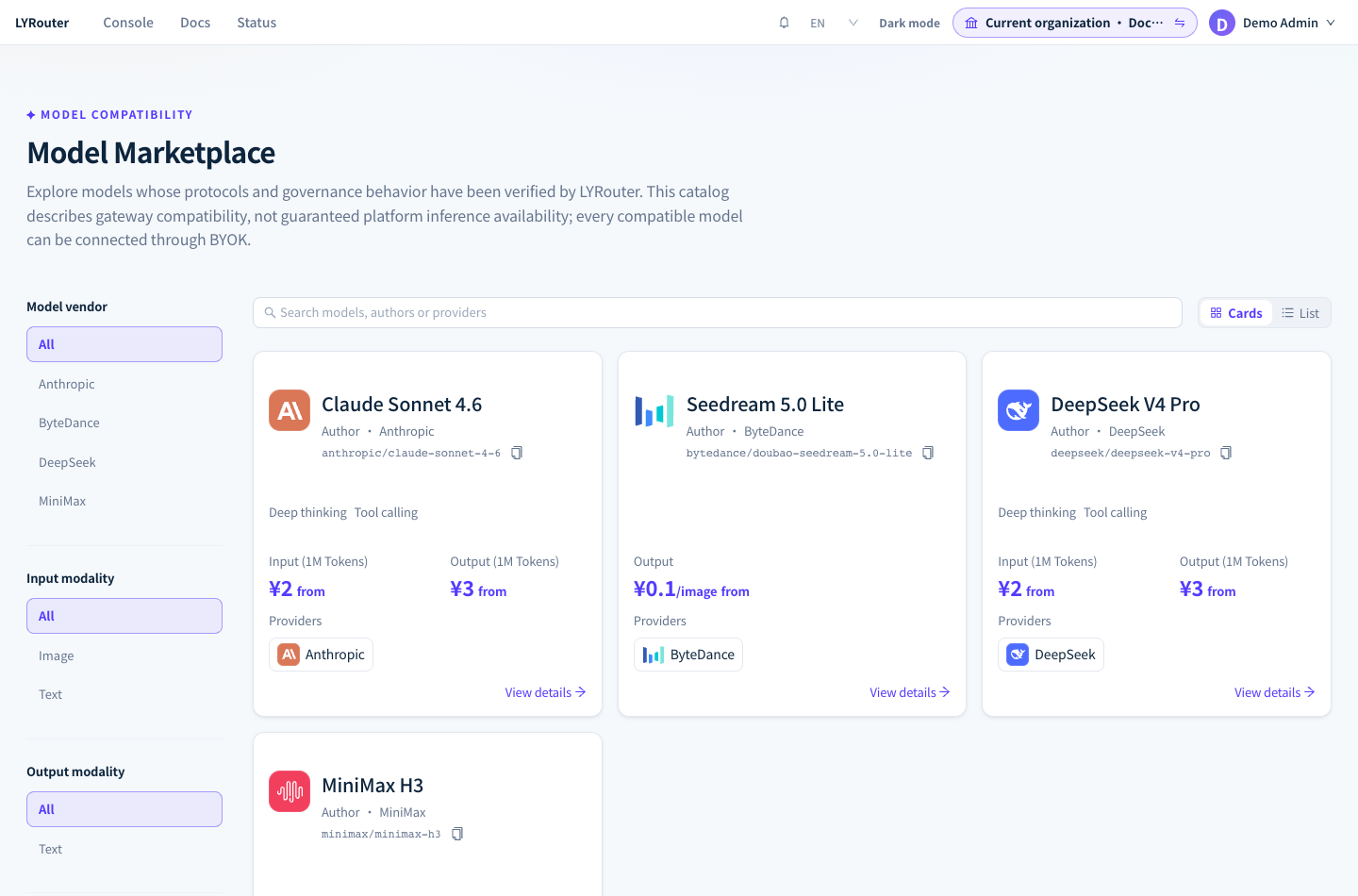
Figure 1: The public model marketplace lists the models the gateway has adapted and can filter by input and output modality; what you can call is decided by the workspace model marketplace. Demonstration data; click the image for full size.
Params on image and video endpoints
On image and video endpoints, the gateway drops some params the selected model does not support and calls it as usual, listing the dropped param names in the X-Gateway-Unsupported-Parameters response header. To get an error in such cases instead, add this to the request:
curl "$LYROUTER_BASE_URL/v1/images/generations" \
  -H "Authorization: Bearer $LYROUTER_API_KEY" \
  -H "Content-Type: application/json" \
  -H "X-Gateway-Strict-Parameters: true" \
  -d '{"model":"google/gemini-3-pro-image","prompt":"A cat sitting by the window"}'
With strict mode on, a param that would be dropped makes the request return 400 unsupported parameters for this model: <parameter> with error.code unsupported_parameters, and the upstream is not called. Which params each model supports and drops is in Multimodal capabilities. Setting the environment variables is covered in Your first model call.
Checking a model's declared capabilities
Call GET /v1/models with an API key. When the model catalog has the information, model entries in the list include:
| Field | Meaning |
|---|---|
api_types |
Endpoints the model declares support for, such as chat_completions, responses and images |
input_modalities / output_modalities |
Input and output modalities, such as text and image |
context_length / max_output_tokens |
Context length and maximum output length |
supported_params |
Params the model declares support for; for reference only, the gateway does not use it to strip params from chat requests |
Context length, tool calling and structured output are finally decided by the upstream. After changing the model, provider or channel, verify params, streaming events and tool calls again with real requests; see Model versions and retirement.
FAQ
I set response_format. Why is JSON sometimes not returned?
Answer: When the request is routed to an Anthropic-protocol channel, response_format is removed during conversion. Check this request's Provider in the request logs and compare it with Upstream request under Raw packets. For stable JSON output, state the output format clearly in the prompt; you can also ask the Owner to disable sources you do not need in the model details; see Connecting multiple providers.
Codex calls return errors, but the same model works with Chat Completions. What should I do?
Answer: Codex uses the Responses endpoint, and its requests are forwarded unchanged to the channel's Responses endpoint. When it returns 400 This model does not support the responses API, switch to a model that declares Responses support. When it returns an upstream error such as 404, the channel serving this request may not provide a Responses endpoint; switch to another model, or ask the Owner to adjust the model's sources.